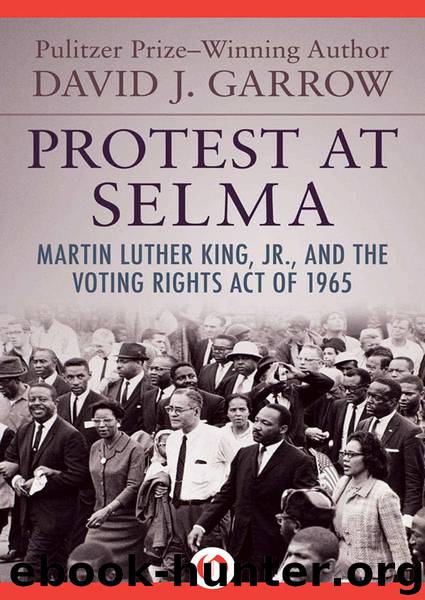
Protest at Selma: Martin Luther King, Jr., and the Voting Rights Act of 1965 by David J. Garrow
Author:David J. Garrow
Language: eng
Format: mobi
ISBN: 9781504011549
Publisher: Open Road Media
Published: 2015-02-17T07:00:00+00:00
Estimated Percentage of Voting-Age Blacks Registered Estimated Number of Black Registrants
1966 1967 1968 1966 1967 1968
Alabama
51.2 53.1 56.7 246,396 255,000 273,000
Arkansas
59.7 62.8 67.5 115,000 121,000 130,000
Florida
60.9 64.6 62.1 286,446 304,000 292,000
Georgia
47.2 54.5 56.1 289,545 334,000 344,000
Louisiana
47.1 53.2 59.3 242,130 273,000 305,000
Mississippi
32.9 45.1 59.4 139,099 199,000 251,000
North Carolina
51.0 50.3 55.3 281,134 277,000 305,000
South Carolina
51.4 50.8 50.8 190,609 189,000 189,000
Tennessee
71.7 71.7 72.8 225,000 225,000 228,000
Texas
61.6 61.6 83.1 400,000 400,000 540,000
Virginia
46.9 55.6 58.4 205,000 243,000 255,000
All Southern States
52.2 56.2 62.0 2,620,359 2,820,000 3,112,000
Sources: 1966: Southern Regional Council, Voter Registration in the South, Summer 1966 (Atlanta: SRC, 1966), as quoted in Congressional Quarterly, Revolution in Civil Rights, 3rd ed. (Washington: Congressional Quarterly Service, 1967), p. 74. 1967: VEP News 1 (September 1967): 1. 1968: VEP News 2 (September 1968): 1. As with the pre-1965 years, it should be emphasized that the majority of these figures represent observers’ best—and often somewhat imaginative—estimates, and not precise tabulations.
The most notable victories for moderation in November occurred in Arkansas, where strong black support propelled Republican Winthrop Rockefeller into the governor’s chair, and in South Carolina, where black voters supplied the margins for Senator Ernest F. Hollings and Governor Robert B. McNair. Blacks themselves also began to register some notable election victories, as Lucius Amerson won election as Macon County, Alabama sheriff and as blacks gained five seats in the Tennessee legislature, bringing their total in the eleven southern legislatures to twenty. Those twenty, however, served in only three states—eleven in Georgia, six in Tennessee, and three in Texas—leaving black southerners in the eight other states without even one member of their race in the state legislatures. Furthermore, while some moderate victories—including a second defeat of Clark by Baker—and a continued decline of explicit racism marked the November races, the darker side of southern politics by no means had disappeared. As one reporter noted, with the South Carolina contests in mind, even though open references to the race issue had all but disappeared, “it is the underlying and motivating issue in all contests.”31
Although most observers chose to concentrate on the positive electoral gains registered by blacks, such as the increase in black elected officials throughout the South from about 72 to 159 as a result of the 1966 elections, far less attention was devoted to a trend whose effect was to reinforce the racial conservatism of white southern politicians: the unprecedented increases in white voter registration across the South which all but outstripped the widely heralded black gains. As two southern political historians recognized a number of years later in commenting upon the numerous 1966 victories of racially conservative whites, “The Maddoxes and Wallaces rode the vote of an expanded white electorate to victory.”32 While it has been suggested that at least some of this white registration increase was a “countermobilization” produced by the initial, heavily publicized black gains, increasing partisan competition, education levels, affluence, and migration in the South may well have affected the growth as well. While no precise explanation for the growth of the white electorate
Download
This site does not store any files on its server. We only index and link to content provided by other sites. Please contact the content providers to delete copyright contents if any and email us, we'll remove relevant links or contents immediately.
| Anthropology | Archaeology |
| Philosophy | Politics & Government |
| Social Sciences | Sociology |
| Women's Studies |
The Secret History by Donna Tartt(19467)
The Social Justice Warrior Handbook by Lisa De Pasquale(12293)
Thirteen Reasons Why by Jay Asher(9118)
This Is How You Lose Her by Junot Diaz(7056)
Weapons of Math Destruction by Cathy O'Neil(6466)
Zero to One by Peter Thiel(5951)
Beartown by Fredrik Backman(5934)
The Myth of the Strong Leader by Archie Brown(5623)
The Fire Next Time by James Baldwin(5581)
How Democracies Die by Steven Levitsky & Daniel Ziblatt(5322)
Promise Me, Dad by Joe Biden(5229)
Stone's Rules by Roger Stone(5186)
A Higher Loyalty: Truth, Lies, and Leadership by James Comey(5087)
100 Deadly Skills by Clint Emerson(5023)
Rise and Kill First by Ronen Bergman(4890)
Secrecy World by Jake Bernstein(4877)
The David Icke Guide to the Global Conspiracy (and how to end it) by David Icke(4849)
The Doomsday Machine by Daniel Ellsberg(4619)
The Farm by Tom Rob Smith(4611)
